
Jackson County Mugshot Records
A booking photograph is an identity image made during an arrest or intake. Jackson County Sheriff’s Office displays a current photograph on each card in its official jail roster. The card also carries the person’s name, booking number, charges, bond, arresting agency, booking date and time, age, sex, and race. It does not carry a release date, release reason, destination, or released-status field. A photo on that roster therefore shows a current county custody record, subject to the sheriff’s warning that the data changes quickly.
Release does not erase the fact that a photograph was maintained. Kansas records schedules treat mugshots and fingerprints as records associated with arrest and inmate files. The underlying Jail/Commitment Record is permanent and includes discharge date, time, and authority. An inmate case file normally remains five calendar years after incarceration ends, while a temporary-holding file normally remains two. Retention tells how long an office keeps material. It does not promise that a mugshot will remain on the public web.
The current roster is useful for matching a person to a booking, but absence has several meanings. The person may have bonded out, completed a county term, been transferred to the Kansas Department of Corrections, or returned to another holding authority. Confirm the custody event through the discharge entry. The image alone cannot answer it.
Jackson County Release Photo Channels
Each official channel has a defined scope. Start with the system that created the custody record, then use a second source to confirm release. Jackson County does not publish a released-person photo gallery, a recent-release tab, or a verified sheriff mobile app. Kansas VINE can report a county-jail custody change, but it is not a durable photo archive. Local press releases may preserve an episodic image, though they are not a release ledger.
| Channel | Has a photo? | How to access it |
|---|---|---|
| Jackson County live roster | Yes, while the card is current | Search by name or booking number on the sheriff roster |
| Sheriff records request | May provide the maintained booking photo | Request the named booking and a narrow date range |
| KASPER | Yes, for covered KDOC records | Search by name or KDOC number after accepting its disclaimer |
| Kansas VINE | Not a reliable photo archive | Use it for a specific county custody status or alert |
| Sheriff press releases and social accounts | Sometimes | Check an official post tied to the event |
A county booking photograph and a KDOC photograph are not interchangeable. KASPER covers people and cases tied to KDOC-operated or funded programs. A person who posted county bond and never entered state custody may have no KASPER result. Conversely, a KASPER image identifies the state corrections record and does not establish that it is the Jackson County intake photograph.
Commercial mugshot publishers and data brokers are intentionally excluded. Their copies may be stale, detached from the final court action, or difficult to correct. An official source gives the best path to the record’s custodian, date, and limits.
Jackson County Mugshots After Release
The sheriff roster is current-only. When a card disappears, its photograph also loses that easy public route. The roster offers no public switch for people released in the last day or three days, and the sheriff does not state a post-release web-retention period. That gap is why a saved booking number and a formal records request matter more than repeated roster searches.
The Jackson County roster interface shows the current search controls and photograph placement:
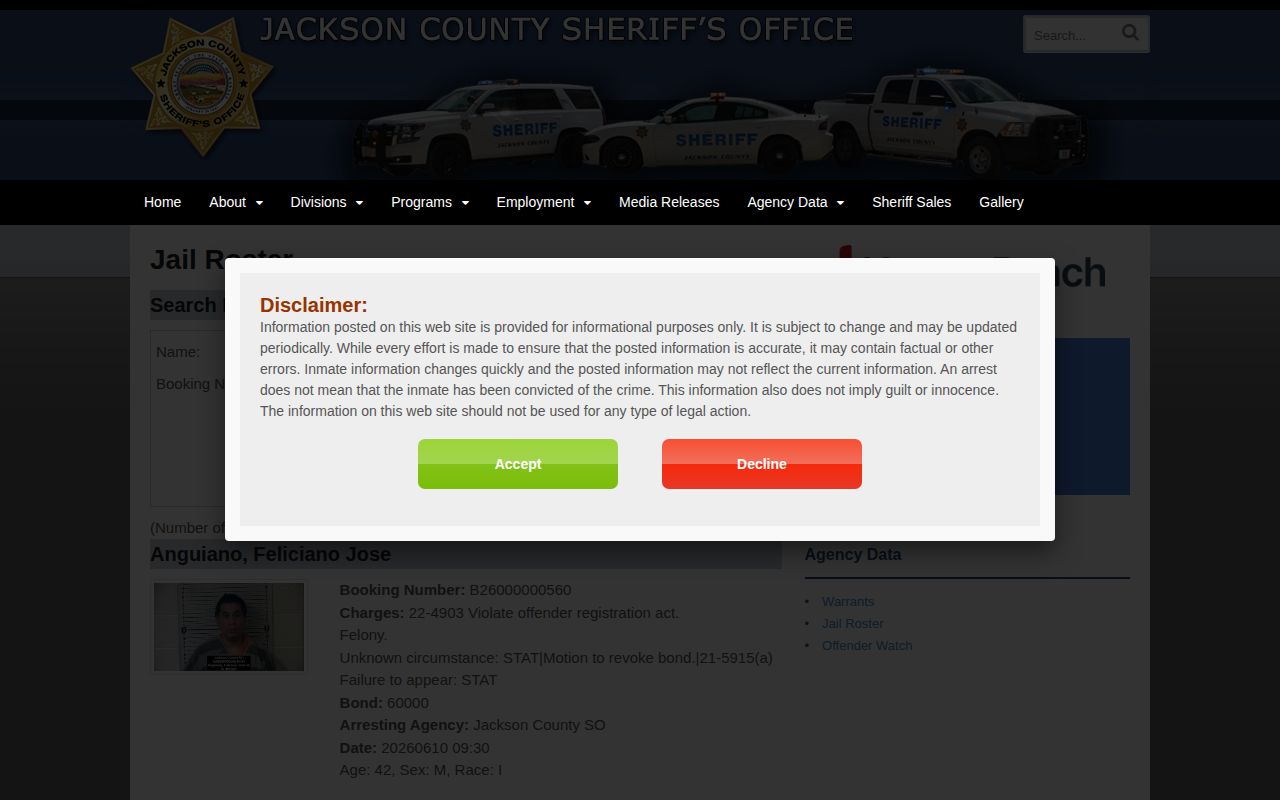
The image illustrates the live-card format, not a list of released inmates. Use the card’s booking number to frame a request before or after the online card changes.
No official Jackson County sheriff app was verified during the source review. Apps for counties with the same name in other states are not substitutes. The sheriff’s own press-release page, Facebook account, and X account can contain a photograph tied to a reported event, but none posts a systematic Jackson County release-photo archive.
For a recent change, record the time when the roster was checked and compare the same booking number in VINE. Then ask correctional staff whether the jail still holds the person. This sequence separates three facts that are often blurred: whether a photograph was once online, whether the county custody episode ended, and which authority caused the departure. The permanent record supplies a stronger answer than a screenshot alone.
Note: A roster photo can vanish from the web while the official booking and discharge records remain subject to their own retention rules.
Request a Jackson County Booking Photo
Send a focused Kansas Open Records Act request to the Jackson County Sheriff’s Office. The office is at 210 U.S. Highway 75, Holton, KS 66436. Its main phone is 785-364-2251 and fax is 785-364-4820. The research found no dedicated online form, published records email, fixed copy fee, or guaranteed response time. Under K.S.A. 45-218, an agency must act on a request as soon as possible and give a response within three business days, but that response may provide the records, request clarification, state a delay, quote a lawful fee, or cite a basis for withholding.
A narrow request reduces mistaken identity and helps the custodian locate the correct custody episode. Ask for an electronic copy if that form works. K.S.A. 45-219 permits reasonable fees tied to access, copies, staff time, and redaction. A fee is not established until the office gives one.
- Give the full name, date of birth if known, booking number, and a tight booking-date range.
- Ask for the maintained booking photograph and booking sheet from that custody episode.
- Request the Jail/Commitment discharge date, time, and authority so the image is not mistaken for proof of current custody.
- Ask for the release order, destination, or receiving agency if recorded and relevant to the departure.
- Request separable open fields if part of the file is withheld, and ask for the statute supporting any denial.
Visual copies of photographs can carry added cost under K.S.A. 45-219(c)(4). A criminal-investigation record may also fall within a discretionary KORA exception under K.S.A. 45-221(a)(10). That means a county booking image should not be described as automatically available in every case. The permanent discharge entry may still yield open release facts even if the office restricts another part.
KDOC Photos for Jackson Releases
Use KASPER only when the person entered a KDOC program or state supervision. Search by first, middle, and last name or KDOC number. The advanced form can narrow by conviction county, including Jackson, plus birth or age data, facility, supervision type, or supervision county. Compare identifiers before relying on the photograph.
KASPER may show a digital photograph, physical description, conviction and case data, current location, movement history, sentence dates, supervision type, and parole office. Its disclaimer says the repository updates each working day, rather than in real time. It also warns that the displayed image date may not be the day the photograph was taken. A movement to prison confirms state custody, while parole, conditional release, or postrelease supervision means prison custody ended but KDOC authority continued.
The KASPER search and released detail demonstrates how a state photograph appears with status and sentence fields:
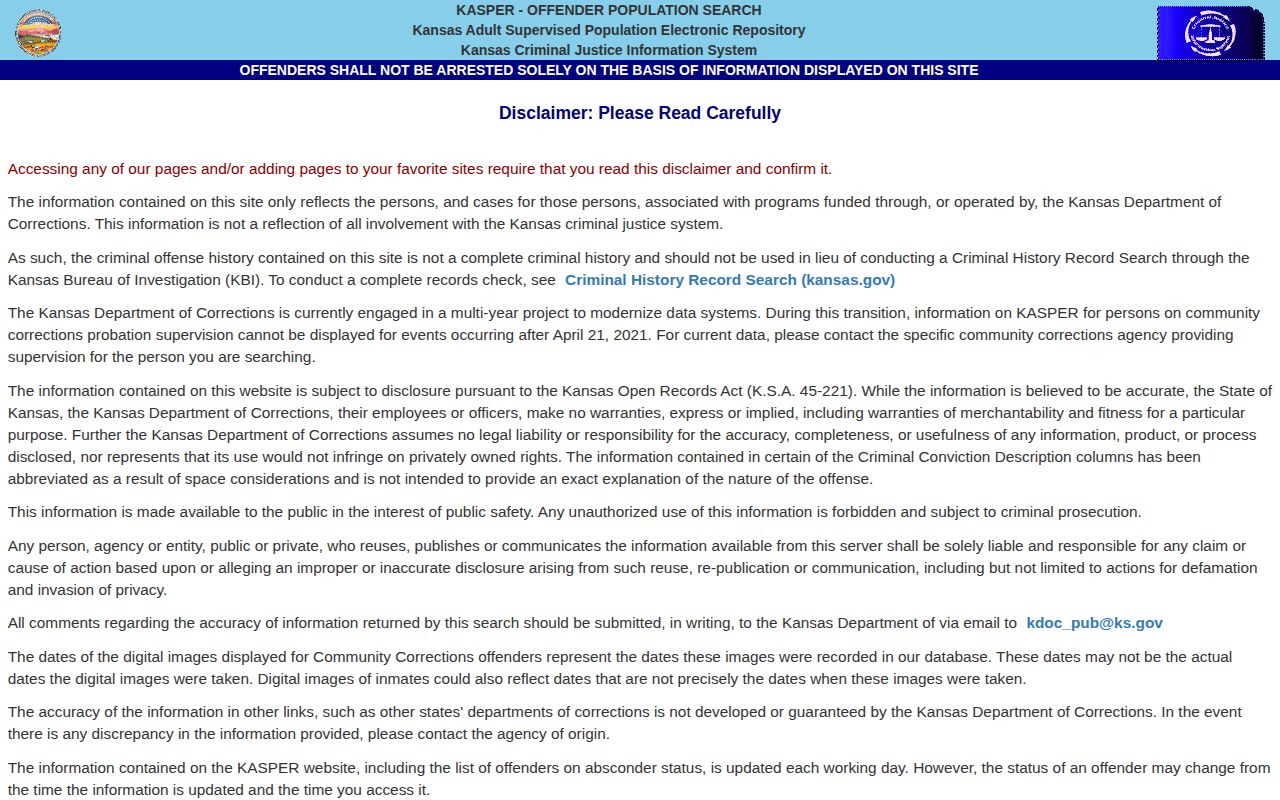
This state image belongs to the KDOC record. It should not be labeled as the county jail mugshot without proof that both images came from the same booking event.
Kansas Rules for Release Mugshots
Kansas law treats state and county images differently. K.S.A. 45-221(a)(29)(A) expressly makes a KDOC inmate’s photograph a public specific-offender field. County booking photographs sit within sheriff records and may be affected by criminal-investigation restrictions, the form of the requested copy, and the status of the related case. Jackson County voluntarily places current booking images on its roster, but that choice does not create a permanent public gallery after a card disappears.
The distinction changes the request path. Ask KDOC for a state corrections photograph when KASPER covers the person. Ask the sheriff for the photo tied to a Jackson County booking. If identity or status matters, pair either photo with numbers, dates, movement entries, or the discharge authority rather than matching a face alone.
Expunged Jackson County Mugshots
Expungement is a court process that limits ordinary public access to a qualifying record. It is not the same as release, and the waiting period usually does not start merely because someone walked out of jail. Under K.S.A. 21-6614, conviction waiting periods generally run from satisfaction of the sentence or discharge from probation, a community-corrections assignment, parole, postrelease supervision, conditional release, or a suspended sentence. The period varies by offense, and some matters are not eligible.
Arrest-record expungement under K.S.A. 22-2410 uses separate grounds, including mistaken identity, a finding of no probable cause, or circumstances in which the proceedings ended without a conviction and statutory conditions are met. A person seeking relief files through the proper court process. Once a record is expunged, access is limited to uses and persons allowed by statute. The order and official custodian, not a roster disappearance, establish that result.
Kansas research did not locate a specific anti-pay-to-remove mugshot statute. That absence should not be read as approval of commercial publication or as a conclusion about every possible remedy. Keep requests with the sheriff, KDOC, or the court that issued an expungement order. Do not send money to an unofficial publisher based on a claim that it controls the government record.
Note: Release, sentence completion, and expungement are separate events, so the relevant date and authority must be checked for each one.
Public Record Search
Sponsored Results