
Jackson County Parole Versus Probation
Start with the sentence, not the label used in casual speech. Kansas parole is a discretionary prison release for an eligible indeterminate sentence. Postrelease supervision is the community phase that ordinarily follows the prison part of a determinate sentence. Probation is a court-ordered community sentence. A person on any of these statuses may be outside the Jackson County Jail, but the legal source and the office that can verify the status differ.
Most determinate, non-off-grid Kansas crimes committed on or after July 1, 1993 do not use discretionary parole. K.S.A. 22-3717 generally places those cases on postrelease supervision after prison. Older indeterminate cases, life sentences, off-grid crimes, and special categories follow different eligibility rules. That is why a percentage calculation cannot establish parole eligibility.
| Status | What it means | Best verifier |
|---|---|---|
| Parole | Board-approved community release on an eligible sentence | KASPER, parole office, Prisoner Review Board record |
| Postrelease supervision | Required community phase after a determinate prison term | KASPER and the listed parole office |
| Probation | Court-ordered community sentence | Jackson County court file and community corrections |
| Sentence discharge | KDOC authority and supervision have ended | Discharge certificate or KDOC record |
- Conditional release
- A statutory release for an indeterminate sentence, followed by supervision.
- Absconder
- A person whom the supervising agency reports as no longer complying with required contact or location rules.
- Revocation
- A formal decision that returns or changes supervision after a proven violation process.
- Discharge
- Completion of the sentence and the supervising authority’s control.
Check Jackson County Post-Release Supervision
KASPER, the Kansas Adult Supervised Population Electronic Repository, is the main public state search. Its advanced form supports parole-supervision county, community-corrections location, supervision type, conviction county, facility, and identity fields. Search carefully because “Conviction County: Jackson” does not mean the person lives in Jackson County or is supervised there.
- Accept the KASPER disclaimer, then search by KDOC number or full name. Use date of birth, alias, and other identity fields to avoid a false match.
- Open the correct record. Read current status, movement dates, supervision type, and parole office together.
- If the result shows parole or postrelease supervision, use the listed office and the official KDOC directory for a current confirmation.
- For probation, search the matching Jackson County case and contact the court or responsible community-corrections agency.
- When formal proof matters, request the existing supervision or discharge record from the office that maintains it.
KASPER updates each working day. It is not a live custody feed. The disclaimer also warns that community-corrections probation events after April 21, 2021 may be incomplete during system modernization. A missing probation event therefore calls for a court and agency check, not a claim that Jackson County probation ended.
The KASPER search interface shows the state fields used for Jackson County parole and postrelease verification.
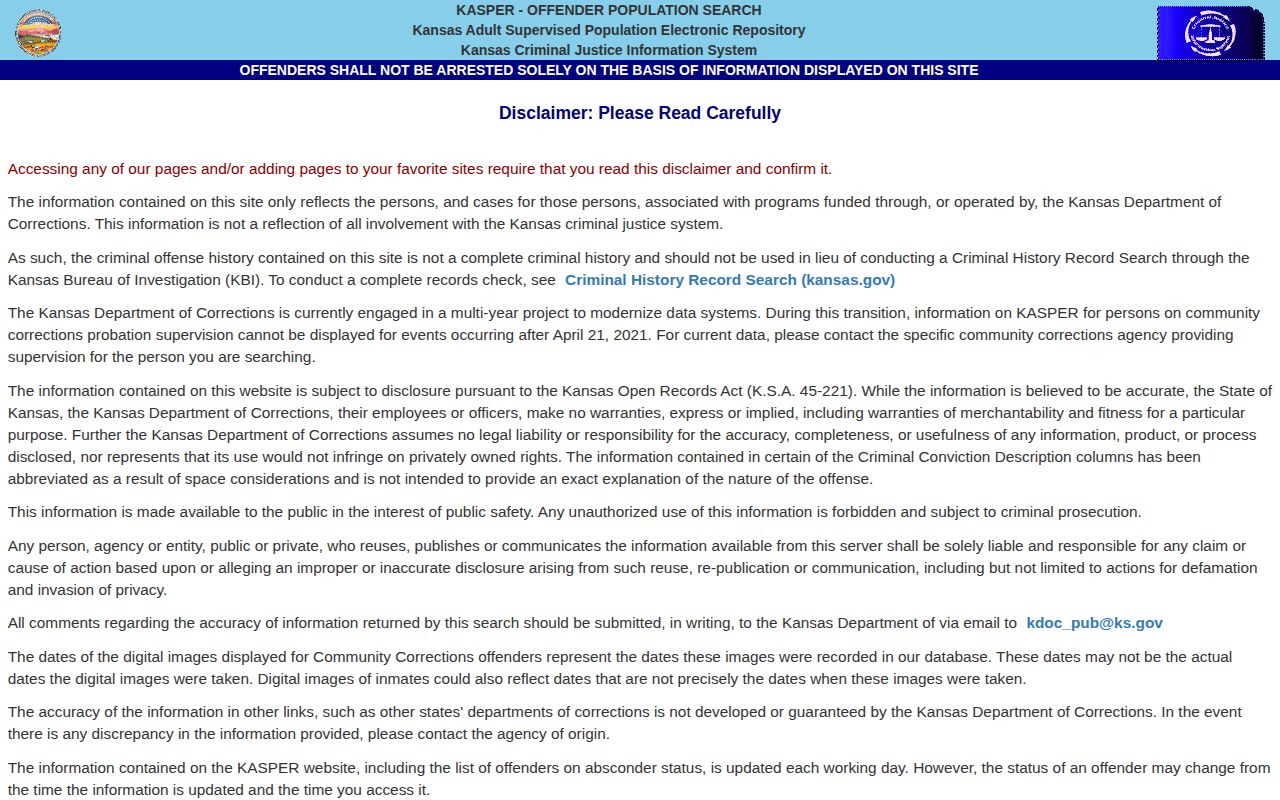
Its advanced filters help separate conviction county, supervision county, and current facility, which are distinct facts.
Jackson County Supervision Contacts
The public KASPER record can identify the parole office maintaining supervision. The research did not establish one fixed local office for every Jackson County person, so the record’s listed office is the safest route. Probation may instead belong to the sentencing court or a community-corrections agency. Confirm the custodian before sending personal records.
714 S.W. Jackson, Suite 300
Topeka, KS 66603
785-296-3317
KDOC records request portal
KASPER data corrections: kdoc_pub@ks.gov
For a Jackson County probation case, the Kansas District Court Public Access Portal can show the order that imposed, modified, revoked, or discharged probation. Court staff can provide an existing public order. They cannot replace the supervising agency’s current status check.
Note: A parole-office location is a supervision field, not proof of a person’s residence or planned release destination.
Jackson County Parole Violations
Supervision conditions are rules a person must follow in the community. Public KDOC fields can include non-protected conditions and violations that resulted in revocation. They do not make medical, treatment, victim, security, or unproved allegations public. An officer may begin an alleged-violation process, followed by a warrant and revocation sequence. That process is not the same as a new criminal conviction.
KDOC also has a parole-absconder search with filters for a last supervision location, including Kansas counties, facilities, federal status, and other states. An entry is a focused supervision lead. It does not by itself prove a new arrest or present placement in the Jackson County Jail.
The official KDOC absconder filters show why a Jackson County parole result must be read within the state disclaimer.
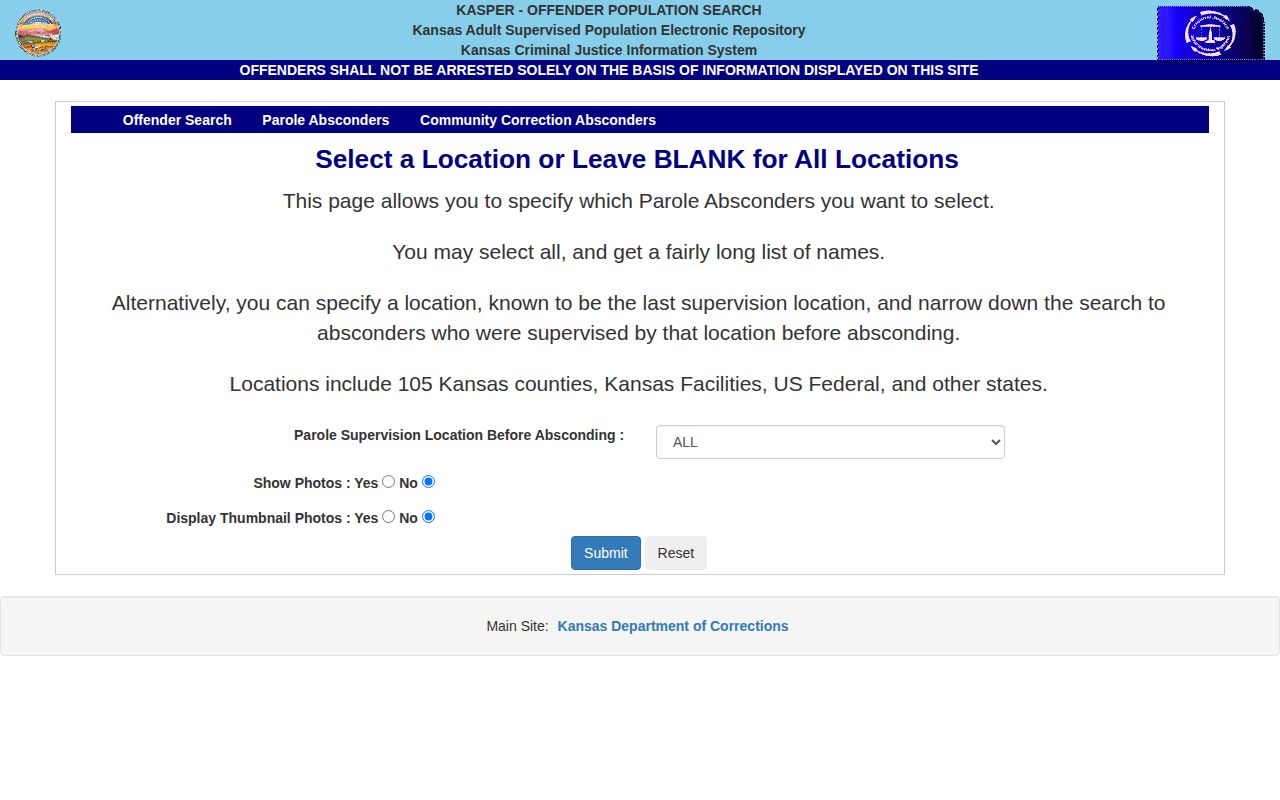
Direct confirmation with the listed supervising office is appropriate when the record may have changed since the last working-day update.
Jackson County Supervision Discharge
Physical release and sentence discharge are separate events. A person can leave prison on parole, conditional release, or postrelease supervision while KDOC authority continues. Maximum-sentence discharge means the sentence and KDOC supervision have ended. When formal confirmation is needed, ask KDOC for the discharge certificate or the record that states the discharge event.
A probation discharge appears in the court case because probation begins with a court order. Read the journal entry or register of actions, then request the underlying order if the portal label is too brief. Kansas conviction-expungement waiting periods often run from sentence satisfaction or discharge from probation, community corrections, parole, postrelease supervision, or conditional release, not merely the date someone left the jail.
The broader Jackson County released inmate search and release-record path explains how a jail discharge entry confirms the earlier physical custody event. That county record should not be substituted for the later supervision discharge.
Note: “Released” can mean outside a facility while “discharged” means the supervising sentence obligation has ended.
Jackson County Warrants After Release
The Jackson County Sheriff maintains an active-warrant database apart from both the jail roster and KASPER. A failure-to-appear or bond-revocation warrant can arise after release. It may explain why someone is wanted, but it proves neither current custody nor the original release event.
Keep the sources separate. KASPER addresses KDOC status and state supervision. The court docket records orders and proceedings. The sheriff warrant list reports a local warrant. The live jail roster asks who appears to be held now. A reliable Jackson County parole or probation check uses each source only for the fact it maintains.
The sheriff’s official warrant screen illustrates this separate local status channel.
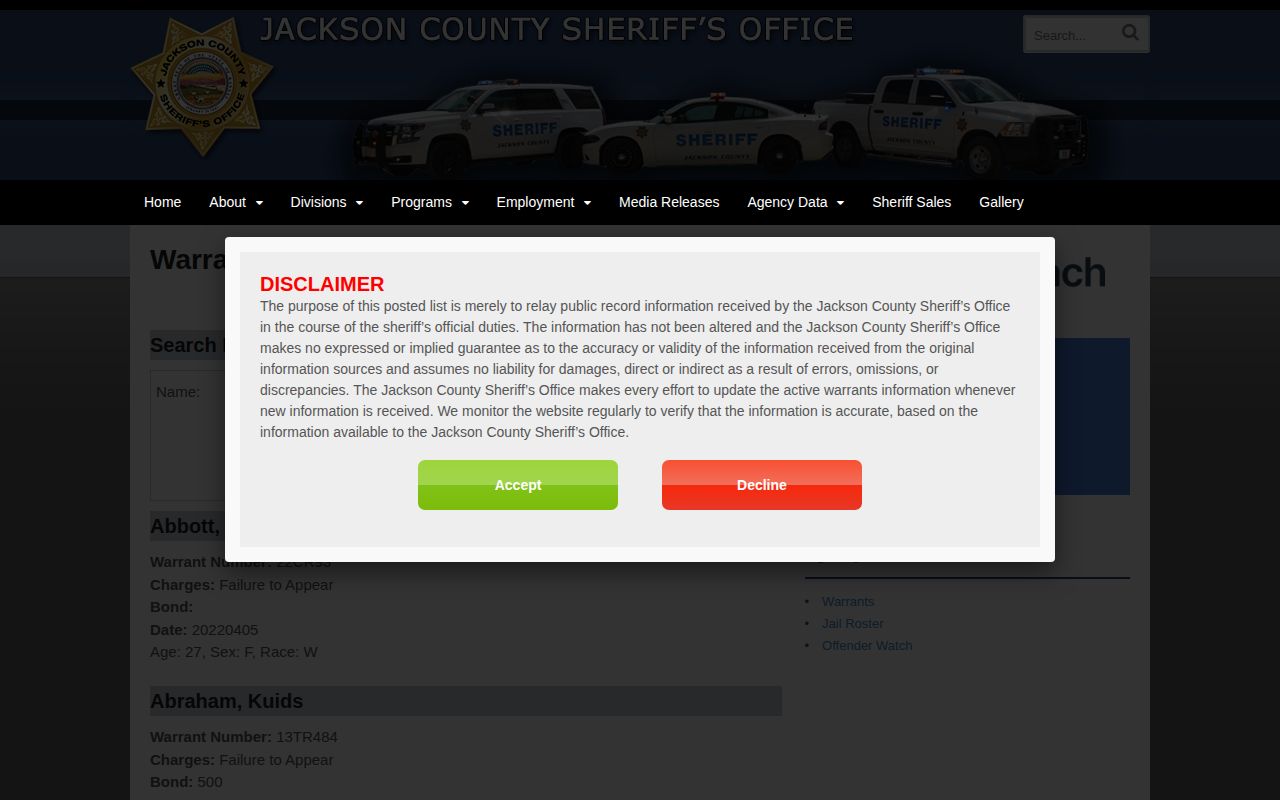
Match the name and warrant details, then use the responsible office for current confirmation rather than treating the image as custody proof.
Identification After Jackson County Release
A lost or stolen Kansas license or identification card can make ordinary post-release tasks harder. Jackson County’s driver’s-license station in Holton can handle replacement of a regular lost or stolen Kansas license or ID by appointment. It is not a full-service station, so callers should confirm that the planned transaction is available before traveling.
The station is in Courthouse Room 206, 400 New York Avenue, Holton, and lists 785-364-3791. Published hours are Monday through Friday, 8:30 a.m. to 4:00 p.m. This service is practical local support, but it does not verify parole, probation, or a custody release. Those facts still come from KDOC, the court, and the originating jail record.
Jackson County Parole Hearing Records
The Kansas Prisoner Review Board calendar lists monthly public-comment sessions and hearing groups. A listed offender entry can include commitment name, KDOC number, offense, case, conviction county, and a KASPER link. “County” on that list is the county of conviction. It is not necessarily the supervision county or future home.
Placement on a hearing list does not grant release. The Board uses the terms parole for a favorable release decision, continue when a decision is postponed, and pass for a denial lasting a stated period. No separate official public person-level decisions search was found. After a hearing, check current KASPER movement and status, then request an existing Board decision record if needed.
The official Board process explains the decision terms and sentence-discharge sequence.

The process confirms why eligibility, a calendar listing, and actual parole release must not be treated as the same event.
A public-comment session occurs before the parole hearing, and a possible release follows later. KDOC says the Board ordinarily conducts a parole hearing in the month before eligibility. A favorable expectation can still be affected by later facts, so the calendar should never replace the person’s current KASPER movement and status. Annual Board reports provide aggregate results, not a current person-level decision.
For an existing individual decision, a focused Kansas Open Records Act request is the documented fallback. Identify the KDOC number, hearing period, and requested decision record. Ask for separable public portions if protected material is present. The Board may notify the offender directly, but the absence of a public results portal does not turn a calendar entry into proof of denial or release.
Conditional release also needs careful wording. It is a statutory community release for an indeterminate sentence, followed by supervision. It is not the same as a discretionary parole grant. Maximum-sentence discharge is later and ends the remaining KDOC authority. These distinctions matter when a Jackson County family is trying to tell whether a person is merely outside prison or has completed all state supervision.
Public Record Search
Sponsored Results