
Jackson County Projected Versus Actual Release
KDOC calls its public estimate the anticipated guidelines release date. It reflects the current sentence calculation for a state prisoner. It is not a promised time at a prison gate. The actual release is later confirmed by movement and status records, the supervising office, or a maximum-sentence discharge certificate.
A Jackson County Jail detainee awaiting court action often has no computed release date. Bond can be posted, a judge can change an order, another agency can place a hold, or the case can move without a set departure day. A person serving a county sentence may have a calculation maintained by the court and jail, but the sheriff publishes no release-date field or local good-time formula.
Leaving the Jackson County Jail for KDOC, another county, tribal custody, or a federal authority is a transfer. It is not community release. The destination and discharge authority decide how the event should be described.
Find Jackson County Projected Release Dates
Choose the source by custody type. KASPER covers people and cases tied to KDOC programs, not every Jackson County booking. The sheriff’s current roster has booking and bond fields but no projected or actual release field.
- Confirm identity with full name, date of birth, booking number, KDOC number, conviction county, and case when available.
- For a state prisoner, accept the KASPER disclaimer and open the correct record. Read status, location, movements, controlling sentence, sentence-begins date, and anticipated guidelines release date together.
- For a county sentence, obtain the court journal entry and jail-credit calculation, then ask correctional staff or the records custodian for the maintained calculation and discharge event.
- For a pretrial person, review bond and court orders while checking for another hold. Do not promise a date that no agency has set.
- After the event, confirm it with the permanent Jail/Commitment discharge entry or the KDOC movement and status record.
KASPER can also display parole-eligibility, conditional-release, and sentence-expiration dates. These labels answer different legal questions. Parole eligibility only permits Board consideration. It does not establish that parole will be granted.
The official KASPER result format places state status, movements, sentence dates, and the anticipated estimate in one record.
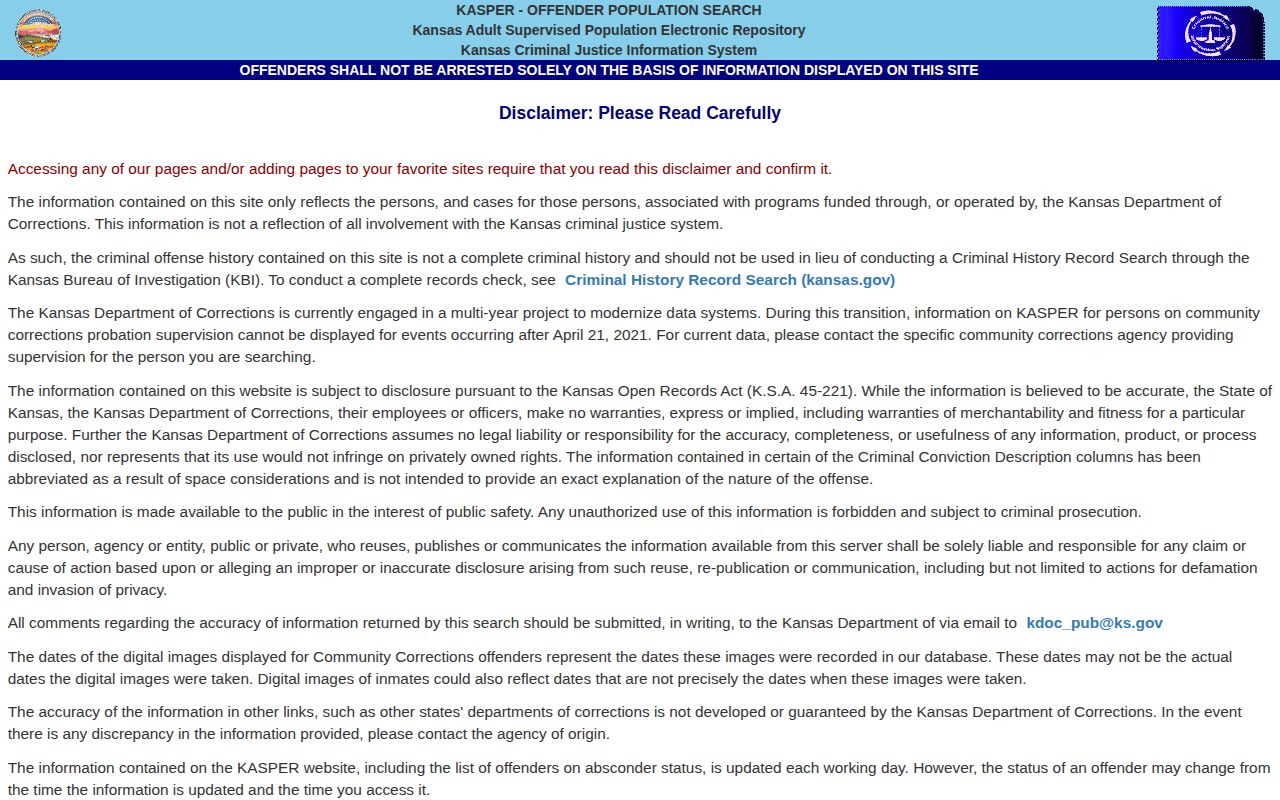
Compare every date to the current status and controlling sentence before drawing a conclusion about release.
Jackson County Good-Time Release Rules
For an ordinary determinate Kansas prison sentence, KDOC describes the release estimate as the sentence maximum less earned good time. Good time is credit that must be earned and retained. It may be withheld or forfeited. Time removed from physical confinement is ordinarily added to the postrelease period, so earlier prison departure may shift time into community supervision rather than erase the full sentence duty.
K.S.A. 21-6821 generally caps good time at 15 percent of the prison portion for determinate crimes committed on or after July 1, 1993. That rule produces the common 85 percent shorthand. Yet qualifying nondrug severity levels and specified drug categories can receive up to 20 percent, depending on offense level and date. The statute also authorizes up to 120 days of program credit for qualifying sentence classes and completed programs, subject to exclusions.
The official Kansas good-time statute displays the categories behind the Jackson County projected release calculation.
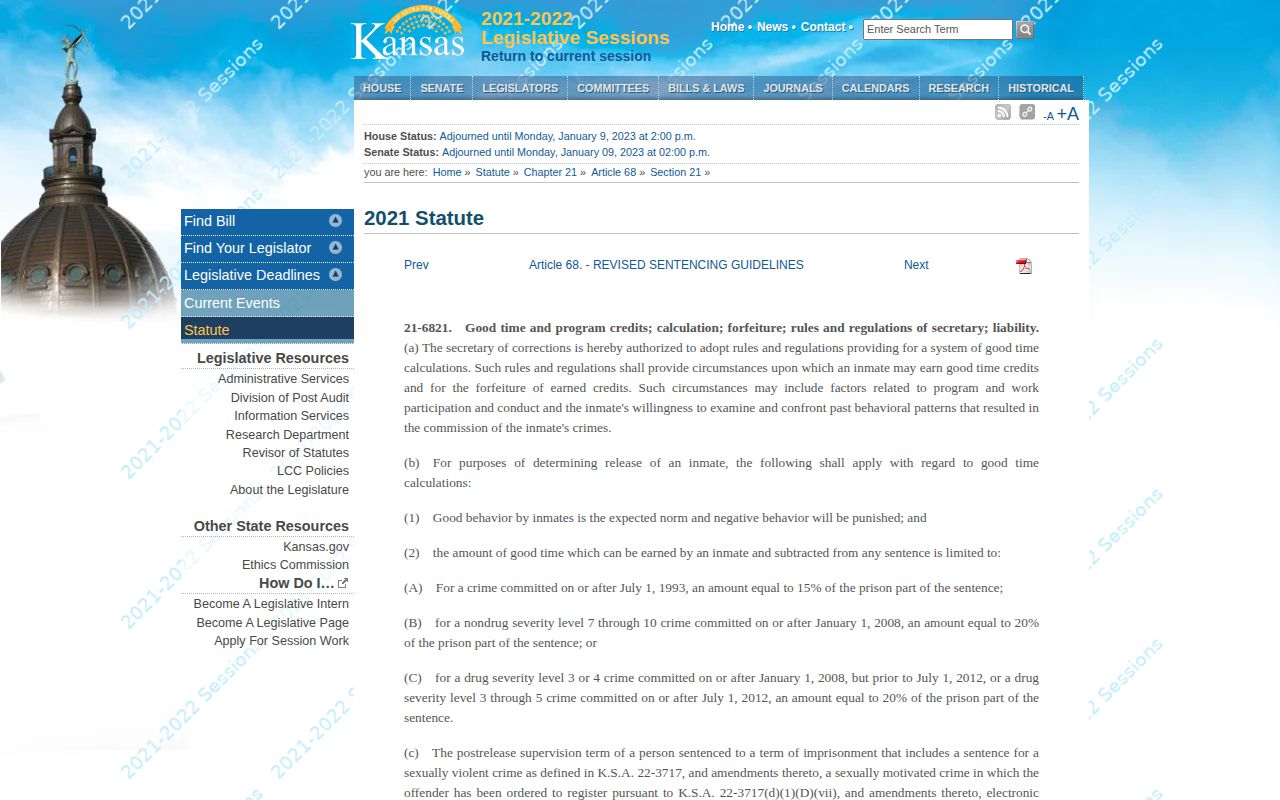
Because the percentages are caps and credits can change, the statute does not support an automatic release promise.
Why Jackson County Release Dates Change
A KASPER estimate is recalculated as the facts supporting it change. Some changes affect the end of prison custody. Others affect the destination or whether release means community placement. Preserve the date on which a result was checked because KASPER updates each working day rather than in real time.
| Factor | Possible effect | Verification |
|---|---|---|
| Good-time earning or loss | Moves the anticipated prison-release estimate | KDOC sentence and discipline record |
| Program credit | May reduce qualifying prison time within the statute | KDOC calculation and completion record |
| New sentence or court order | Changes controlling terms or credit | Court journal entry and KDOC update |
| Jail credit | Credits eligible pre-sentence confinement | Journal entry and sentence calculation |
| Detainer or hold | May route the person to another authority | Movement record and receiving agency |
| Parole decision | Grant, continue, or pass affects an eligible indeterminate case | Board record and current KASPER status |
Special sentence rules, disciplinary decisions, and administrative corrections can also matter. Where a label is unclear, request the underlying record rather than translating it into a guaranteed date.
Confirm Jackson County Actual Release
For county custody, request the Jackson County Sheriff’s permanent Jail/Commitment entry showing discharge date, time, and authority. Ask for destination or receiving agency if recorded. That record separates community release from a transfer. A court order can explain the legal basis but may be signed before the person physically leaves.
For state custody, read KASPER’s latest movement and current status. Parole, conditional release, and postrelease supervision mean prison custody ended while KDOC authority continues. Sentence discharge indicates completion of the state sentence. A discharge certificate offers stronger proof when formal confirmation is required.
Kansas VINE is limited to county-jail custody and does not include KDOC state prisoners. The Jackson County VINELink inmate search can provide a county custody-change alert, but it may not give the exact reason or destination. Use the event record for those facts.
Note: A release notification confirms a reported status change, while the originating agency record supplies the event detail.
Jackson County’s 85 Percent Question
There is no single automatic 85 percent calculation for every Jackson County sentence. The 15 percent cap applies to a broad determinate category, while qualifying classes can reach a 20 percent cap and some people may earn limited program credit. Credits still must be earned, retained, and applied to the correct sentence structure.
Indeterminate, life, and off-grid cases follow different minimums and parole rules under K.S.A. 22-3717. A parole-eligibility date is not a projected release date. It marks when Board consideration may occur. The official anticipated guidelines release date is the better public estimate for a determinate KDOC case.
The Prisoner Review Board process distinguishes parole decisions from sentence discharge.

This distinction prevents an eligibility date or favorable expectation from being reported as an actual departure.
Jackson County Jail Sentence Dates
No official Jackson County jail good-time formula, weekend adjustment, holiday rule, or release-processing time was found. KDOC’s prison credit statute should not be applied mechanically to a county term. Ask the court for the journal entry and jail-credit finding, then ask the jail for its existing calculation and the eventual discharge entry.
Jackson County Sheriff correctional staff can be reached at 785-364-4121. The main office is at 210 U.S. Highway 75, Holton, KS 66436, with a main number of 785-364-2251. No fixed records fee, dedicated records email, or public counter hours were documented, so contact the office before visiting or submitting a request.
If a calculated date lands on a weekend or holiday, ask the jail what its record shows. Do not invent a Friday-release policy. Another hold or receiving authority can also change the destination even when the county sentence itself is complete.
Request Jackson County Release Calculations
A focused records request should name the person, give a booking or KDOC number when known, and identify a narrow confinement period. For the sheriff, request the existing Jail/Commitment discharge entry, release authority, jail-credit calculation if maintained, and destination or receiving agency if recorded. Ask for separable open fields if another part is withheld.
For KDOC, use the online records portal and request the status page, movement history, sentence structure, anticipated guidelines release date, and discharge certificate if one exists. The office address is 714 S.W. Jackson, Suite 300, Topeka, KS 66603, and the main telephone is 785-296-3317.
The Jackson County release-record search covers the permanent county discharge fields and the broader request path. Keep the projected calculation and the completed release event as separate records.
Kansas open-records rules require agency action as soon as possible and no later than the end of the third business day. That deadline can be an acknowledgment explaining delay and the earliest production date, not guaranteed delivery of the calculation within three days. Reasonable actual-cost fees and advance payment may apply. Jackson County has no published fixed release-record price, so ask for an estimate before authorizing a broad search.
A narrow request improves the result. For a county case, provide the full name, birth date if known, booking number, case number, and the smallest useful confinement range. Request existing records instead of asking staff to calculate a new date. If the jail does not maintain the court’s credit finding, direct that part to the district clerk. If KDOC does not maintain a county discharge entry, direct the question back to the sheriff.
When two official dates conflict, retain the source and check time for each. A court order may precede physical discharge. KASPER may remain on the prior working-day status through a weekend. A VINE update can lag the facility event. The permanent sheriff discharge entry is the strongest county event record, while KDOC movement and discharge documents control the state event.
Sentence expiration is another distinct date. It may occur after prison release because postrelease supervision continues in the community. Similarly, an anticipated guidelines release date can mark the expected end of prison confinement while good time is added to the supervision phase. Reporting the earlier date as complete sentence discharge would overstate what the KDOC record says.
For an indeterminate case, read the minimum, parole eligibility, conditional-release date, and maximum or expiration information as a set. The Prisoner Review Board can grant parole, continue deliberation, or pass the case for a stated period. Only the current decision and movement record can show whether eligibility led to an actual prison departure.
A request for the anticipated guidelines release date should include the KDOC number and controlling case when known. Ask for the current calculation and its effective date, not a new forecast made by records staff. If the estimate changed, movement, sentence, credit, program, or court records may identify the basis. Protected treatment or security material can remain closed while separable public sentence dates are supplied under Kansas law.
Use cautious date language in personal notes. “KASPER displayed an anticipated guidelines release date when checked” preserves both the field name and timing limit. “Will be released” removes both limits and can be wrong after a credit loss, new sentence, detainer, or recalculation. Actual release should be stated only after the relevant county discharge or KDOC movement record confirms it.
Public Record Search
Sponsored Results